Posts from Hakluyt Society authors, editors, series editors and grant recipients
Interesting background stories from the research work of Hakluyt Society authors, editors, series editors and grant recipients
New Edition: John Martin’s “An Account of the Natives of the Tonga Islands”
by Nigel Statham In 1963, when I was a nineteen-year-old undergraduate, I accompanied Danish archaeologist Dr Jens Poulsen to Tonga. Dr Poulsen was the first archaeologist to use modern archaeological excavation methods to investigate Tongan antiquity. Tonga was well off the beaten track in those days, still sometimes referred to by Captain James Cook’s name for the archipelago, the Friendly Islands. There was still no regular aerial transport, and most visitors travelled on cargo ships. When I returned to Australia, my father marked the occasion with the gift of a book, John Martin’s Account of the Natives of the Tonga Islands …from the extensive communications of Mr William Mariner, several [...]
Read More
Surprises of Travel through Java in the Nineteenth Century
Judith E. Bosnak and Frans X Koot (2020), The Javanese Travels of Purwalelana. A Nobleman’s Account of his Journeys Across the Island of Java (1860-1875) When traveller Candranegara, alias Purwalelana, woke up he was startled. The guardhouse where he had just spent the night had been completely covered with a fine silken cloth and, moreover, a lavish breakfast awaited him - comprising coffee, sticky rice balls, eggs and sliced seasoned deer meat. As it turned out the village head had organized this special treat when he learned - late at night - that a nobleman had arrived near to his village, seeking refuge in a simple hut. So, replete with food and drink the traveller continued his journey through Java, at that time part of the Dutch East Indies in the Malay Archipelago. The Javanese Travels of Purwalelana (henceforth The Travels) is a remarkable travelogue in many [...]
Read More
The Voyages and Manifesto of William Fergusson
Edited by Derek Elliott, The voyages and manifesto of William Fergusson, a surgeon of the East India Company 1731-1739. Unlike the subjects of most Hakluyt volumes, William Fergusson was not an adventurer, explorer, or a member of a famous expedition. Rather, he was an apprentice apothecary-surgeon sailing the well-plied routes of the East India Company's growing trans-national commercial network. The volume reproduces – with annotations and an introduction – the twenty-two diaries that Fergusson composed toward the end of his life in 1767, which recount four voyages he made as a young man calling at ports in the British Isles, southern Africa, Yemen, India, Malaya, China, and St Helena in [...]
Read More
‘New Caledonia’ and mythmaking in the Darien Scheme
My project in the Spencer Collection at the University of Glasgow was largely concerned with primary print and manuscript materials relating to the ‘Darien Scheme’. The Darien Scheme was orchestrated by the Company of Scotland Trading to Africa and the Indies (1695-1707) in the late seventeenth-century and involved the attempted establishment of a Scottish settlement and trade emporium dubbed ‘New Caledonia’ upon the Isthmus of Darien in Central America (1698-1700). While the effort proved abortive, the Scheme and its collapse has long been the focus of political and economic historians for its assumed role as a catalyst for the Union of Scotland and England in 1706/7. More recent scholarship on [...]
Read More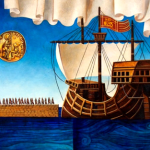
Encounters with the Querina
My first encounter with the Querina was entirely serendipitous. At the time, I was completing a research project on the Italian translation of the Book of John Mandeville, the account of the infamous fourteenth-century ‘English knight’ who claimed to have travelled to Jerusalem and throughout the exotic East. Working in a small, regional Italian library, I called up an early fifteenth-century manuscript of the Book. When the volume arrived, I was surprised to find that it also contained another text, written in the same neat hand. It told the incredible story of the Querina, a Venetian merchant ship which was sailing from Crete to Flanders in 1431 when it was [...]
Read More
Cosmopolitan Convicts? 19th-century convicts in Bermuda and Gibraltar
In this post, I apply the concept of cosmopolitanism to an unusual group of people: convicts. More than 12,000 British and Irish male convicts were transported to the British penal colonies of Bermuda and Gibraltar between 1824-75. During the day convicts worked on the Royal Naval dockyards, mostly quarrying and transporting stone for building projects, and were shut up at night on prison hulks or on-shore barracks. To what extent did the ‘cosmopolitanism’ of these naval hubs shape the convicts’ ‘ways of being in the world’? Were convicts included in the bustling, mixed social worlds of these port-cities, or were they segregated? To answer, these questions, I refer to texts [...]
Read More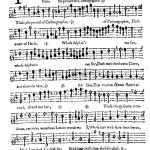
Music-making, Hakluyt and Early Modern Travel Knowledge
Thomas Weelkes’s (1576-1623) anonymously-authored bipartite madrigal for six voices, “Thule, the period of cosmographie” (1600), paints a scene of strange spectacle complete with merchants from far off places, ‘flying fishes’, treasures and goods from abroad, foreign islands, exotic volcanoes and other wonders of exploration of the known world: Thule, the period of Cosmographie, Doth vaunt of Hecla, whose sulphureous fire Doth melt the frozen Clime, and thaw the Skie; Trinacrian Ætna’s flames ascend not higher: These things seem wondrous, yet more wondrous I, Whose hart with feare doth freeze, with love doth fry. The Andalusian Merchant, that returnes Laden with cutchinele and China dishes, Reports in Spaine how strangely Fogo [...]
Read More
Coming from afar
As an historian of travel, I have looked at railway passengers' experiences of distance. But what was the meaning of distance for the people along the tracks, as they observed the machines carrying those passengers thundering past? An important painting from the 1880s addresses precisely this question. 'Il vient de loin' - he/it comes from afar - by Dutch impressionist Paul Joseph Constantin Gabriël has at least three things to say about distance. Paul Joseph Constantin Gabriël, 'Il vient de loin' 1) This painting problematizes progress. Many visual and literary artworks of the nineteenth century set up a dichotomy between tradition and progress, between nature and technology, between a supposedly [...]
Read More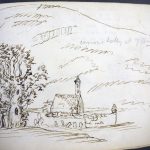
A 19th-Century Perspective on Ireland – following in the footsteps of John (Fiott) Lee
In July 1806, John Lee set out from London to Holyhead where, four weeks later, he boarded the packet to Dublin. Over the following six months, he walked hundreds of miles, filling five notebooks and three sketchbooks with on-the-spot observations and illustrations. ‘Curious holly at 7 Churches [Glendalough]’. By John Lee, 11 September 1806 (SJC, MS U.30 (6), f. 62r). By permission of the Master and Fellows of St John’s College, Cambridge. Born John Fiott in 1783, the son of John Fiott, a merchant, and Harriet Lee of Hartwell, Buckinghamshire, from 1815 he assumed the surname Lee to fulfil the requirements of an inheritance. I refer to him by that [...]
Read More
The voyage of Captain John Narbrough to the Strait of Magellan and the South Sea in his Majesty’s Ship Sweepstakes 1669-1671
In May 1669 Captain John Narbrough was appointed to command HMS Sweepstakes for a voyage to the West Indies, Shortly thereafter an adventurer who has gone down in history as Don Carlos (he gave different versions of his name, nationality and accounts of his life to virtually everyone with whom he came in contact) submitted a proposal to King Charles II for a voyage to South America with an apparent view to establishing trading relation with the native inhabitants and stirring up a rebellion against the Spanish authorities. The King, having had this proposal investigated, agreed to sending a frigate with a pink in company on a voyage of discovery with [...]
Read More