Captain Cook Conference in Paris on 7th-8th February 2020
An International Conference on Captain James Cook’s Voyages (1768-1779) 7th-8th February 2020 Sorbonne Université Organised jointly by the Hakluyt Society, the Society for the Study of Anglophone travel literature (SELVA), Histoire et Dynamique des Espaces Anglophones (HDEA) and Voix Anglophones: Littérature et Esthétique (VALE). VENUE: Sorbonne University, Amphithéâtre Georges Molinié, Maison de la Recherche, 28 rue Serpente, 75006 Paris. Programme: Friday 7 February 2020: 8.45-9.00: Welcome addresses 9.00-10.35: Session 1: “Visions of Paradise” Chair: Pierre Lurbe (Sorbonne Université) 9.00-9.25: Anja Winters (University of Vienna), “Paradise Lost - An essay on Terra Australis Incognita and Captain James Cook” 9.25-9.50: Vanessa Alayrac-Fielding (Université de Lille), “From William Hodges’s View of Matavai Bay (1776) [...]
Read More
Cosmopolitan Convicts? 19th-century convicts in Bermuda and Gibraltar
In this post, I apply the concept of cosmopolitanism to an unusual group of people: convicts. More than 12,000 British and Irish male convicts were transported to the British penal colonies of Bermuda and Gibraltar between 1824-75. During the day convicts worked on the Royal Naval dockyards, mostly quarrying and transporting stone for building projects, and were shut up at night on prison hulks or on-shore barracks. To what extent did the ‘cosmopolitanism’ of these naval hubs shape the convicts’ ‘ways of being in the world’? Were convicts included in the bustling, mixed social worlds of these port-cities, or were they segregated? To answer, these questions, I refer to texts [...]
Read More
Music-making, Hakluyt and Early Modern Travel Knowledge
Thomas Weelkes’s (1576-1623) anonymously-authored bipartite madrigal for six voices, “Thule, the period of cosmographie” (1600), paints a scene of strange spectacle complete with merchants from far off places, ‘flying fishes’, treasures and goods from abroad, foreign islands, exotic volcanoes and other wonders of exploration of the known world: Thule, the period of Cosmographie, Doth vaunt of Hecla, whose sulphureous fire Doth melt the frozen Clime, and thaw the Skie; Trinacrian Ætna’s flames ascend not higher: These things seem wondrous, yet more wondrous I, Whose hart with feare doth freeze, with love doth fry. The Andalusian Merchant, that returnes Laden with cutchinele and China dishes, Reports in Spaine how strangely Fogo [...]
Read More
Gift-giving in early modern European encounters with Southeast Asia
From the earliest European contact with Southeast Asia through to the era of ‘high imperialism’, the process of gift-giving sits at the fulcrum of a dynamic relationship; it is an instance of continuity apparent through several centuries of dramatic change over the course of which rough-and-ready trade deals came to be replaced by fully functioning imperial hegemony. My research has addressed two broad questions: what role did the gift play in this context and what can be learnt from examining this area of history through the lens of reciprocal gift exchange rather than within the conceptual framework of an ‘age of commerce’? The role of the gift Initial encounters between [...]
Read More
Programme: Hakluyt Society Symposium 2019 – Rethinking Maritime Encounters
Hakluyt Society Symposium 2019: “Rethinking Power in Maritime Encounters”, Leiden, 5-6 September 2019 Organised by the Hakluyt Society in collaboration with Leiden University's Institute of History, the Linschoten-Vereeniging, and Itinerario Thursday 5 September 08:00 – 8:30 registration / welcome 08:30 – 10:20 panel 1 [Labour Relations] Pepijn Brandon – ‘Varieties of Force: Experiments in Coerced Labour on Naval Shipyards During the Industrial Revolution’ Maria Vann – ‘“The Bloomer Controlled the Whole of Us:” The Dichotomy of Female Slave Ship Owners and Maritime Women as Agents of Power’ Richard Blakemore – ‘The Meanings of Mutiny in Early Modern Seafaring’ Leonardo Moreno Alvarez – ‘Fraudsters, Grifters, and Divers: The Logistics of [...]
Read More
Oxford, Richard Hakluyt and the Hakluyt Society
This post was originally written for the Oxford University Pensioners' Association Newsletter, which explains its focus on Oxford, and is reproduced from the current issue with permission. Academics today are encouraged to strive for ‘impact’: they are told they should communicate with a broader public than their specialist communities and demonstrate the value of their research to society at large. Richard Hakluyt was an Oxford scholar of the Elizabethan era, who made it his business to carry his scholarship into the wider world of literature, publication, commerce and politics. He worked hard all his life in pursuit of a very particular (and, as it turned out, prescient) thesis that he [...]
Read More
Coming from afar
As an historian of travel, I have looked at railway passengers' experiences of distance. But what was the meaning of distance for the people along the tracks, as they observed the machines carrying those passengers thundering past? An important painting from the 1880s addresses precisely this question. 'Il vient de loin' - he/it comes from afar - by Dutch impressionist Paul Joseph Constantin Gabriël has at least three things to say about distance. Paul Joseph Constantin Gabriël, 'Il vient de loin' 1) This painting problematizes progress. Many visual and literary artworks of the nineteenth century set up a dichotomy between tradition and progress, between nature and technology, between a supposedly [...]
Read More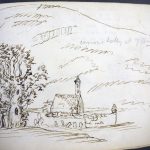
A 19th-Century Perspective on Ireland – following in the footsteps of John (Fiott) Lee
In July 1806, John Lee set out from London to Holyhead where, four weeks later, he boarded the packet to Dublin. Over the following six months, he walked hundreds of miles, filling five notebooks and three sketchbooks with on-the-spot observations and illustrations. ‘Curious holly at 7 Churches [Glendalough]’. By John Lee, 11 September 1806 (SJC, MS U.30 (6), f. 62r). By permission of the Master and Fellows of St John’s College, Cambridge. Born John Fiott in 1783, the son of John Fiott, a merchant, and Harriet Lee of Hartwell, Buckinghamshire, from 1815 he assumed the surname Lee to fulfil the requirements of an inheritance. I refer to him by that [...]
Read More
The voyage of Captain John Narbrough to the Strait of Magellan and the South Sea in his Majesty’s Ship Sweepstakes 1669-1671
In May 1669 Captain John Narbrough was appointed to command HMS Sweepstakes for a voyage to the West Indies, Shortly thereafter an adventurer who has gone down in history as Don Carlos (he gave different versions of his name, nationality and accounts of his life to virtually everyone with whom he came in contact) submitted a proposal to King Charles II for a voyage to South America with an apparent view to establishing trading relation with the native inhabitants and stirring up a rebellion against the Spanish authorities. The King, having had this proposal investigated, agreed to sending a frigate with a pink in company on a voyage of discovery with [...]
Read More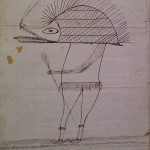
Messy Lives on the Upper Guinea Coast: The Church Missionary Society and its Representatives
When I first began to explore the correspondence of the various Church Missionary Society’s agents in Sierra Leone during the summer of 2011, I confess that I knew very little about them. I was primarily conducting research about how body marks and identity were connected, and was hoping to find evidence of drawn or described body marks such as tattoos and scarification. Missionary accounts seemed like a good place to begin, but as it happened, I never did find descriptions of scarification or tattoo. What I found were lives. And as I read further, researching the authors and working to reconstruct the trajectories of their pupils, I realized how fascinating, [...]
Read More