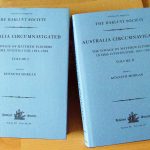
Australia Circumnavigated: The Story of the HMS Investigator
By Professor Kenneth Morgan HMS Investigator, the ship supplied to Flinders for his Australian circumnavigation, was built in 1795 by Henry Rudd as a collier at Monkwearmouth, near Sunderland (county Durham). Originally named the Fram, this vessel of 334 tons was 100 feet long, about 29 feet on the beam, with a draught of around 14 feet and 19 feet depth of hold. She was a three-masted, square-sterned ship built to ply the route from the north-eastern coalfields around East Anglia to London. The Navy Board purchased the ship at Deptford in April 1798 and renamed her the Xenophon. The vessel was then converted to an armed sloop. This mainly [...]
Read More
A Short Life of Matthew Flinders (1774-1814)
By Professor Kenneth Morgan Born into a medical family, with no seafaring connections, Matthew Flinders decided while still a teenager that he wanted to pursue a naval career that focused on maritime exploration. He had read Robinson Crusoe as a child, and his imagination was stimulated by a tale of adventure in a far-distant island. As a young naval recruit, he had a varied time sailing with Bligh in the Providence on his second breadfruit voyage to the Pacific and Atlantic oceans (1791-3) and serving in HMS Bellerophon (1793-4) in the naval war against revolutionary France, culminating in the naval battle of the Glorious 1st June. Flinders made his name [...]
Read More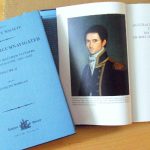
Matthew Flinders and the Circumnavigation of Australia, 1801-1803
Matthew Flinders (1774-1814) was the first navigator to sail all the way around the Australian coastline, proving it to be a separate continent. He also compiled detailed charts of substantial parts of its shores and islands, at a level of accuracy which meant that they remained useful well into the nineteenth century. The Hakluyt Society’s edition in two volumes includes some photographic extracts from these charts, together with specially-drawn maps detailing the route of the voyage. The voyage had more than its fair share of both triumphs and tragedies, recounted in Flinders’s own words and carefully edited by Professor Kenneth Morgan of Brunel University, who explains unfamiliar nautical terms and [...]
Read More
2015 Hakluyt Society Essay Prize runner-up Amy Bowles on “Sir Henry Mainwaring’s ‘A Brief Abstract’”
The manuscript circulation of Sir Henry Mainwaring’s "A Brief Abstract, Exposition and Demonstration of all Parts and Things belonging to a Ship and Practique of Navigation". By Amy Bowles In the early 1620s, the naval officer and reformed pirate Sir Henry Mainwaring composed what is now thought to be the earliest extant dictionary of nautical terms. The Brief Abstract, Exposition and Demonstration of all Parts and Things belonging to a Ship and Practique of Navigation contains around 600 entries, alphabetically ordered with a preface, table of contents, and often a decorative title-page. Mainwaring explained the necessity of this work, writing that ‘very few Gentlemen (though they be called Sea-men) doe [...]
Read More
2015 Hakluyt Society Essay Prize winner: “Printing the Pacific”
By Katherine Parker I am grateful to have been chosen as an Honorable Mention in the Hakluyt Society’s Essay Prize Contest. As a student member and active participant, I think it vital that more early-career scholars join organizations such as the Hakluyt Society. New minds can bring fresh topics and methodologies, but younger colleagues also benefit from interaction with more seasoned scholars who can assess and direct their work. My own research, including the essay discussed here, owes a great debt to previous historians of exploration and encounter, and it is to them, especially Glyndwr Williams, that I credit my intellectual development. In the paper submitted to the Hakluyt Society, [...]
Read More
2015 Hakluyt Society Essay Prize
First, some words about the 2015 prize run. This year the prize committee consisted of Daniel Carey, Surekha Davies (Chair), Felipe Fernández-Armesto, Peter Hulme, Claire Jowitt and Suzanne Schwartz. They announced the results during the 169th Annual General Meeting of the Hakluyt Society, which took place in London on Wednesday 26 June 2015. Among a number of high-quality submissions, the committee held the opinion that the single outstanding contribution was the essay by Owain Lawson (Columbia University), entitled: ‘Constructing a Green Museum: French Environmental Imaginaries of Syria and Lebanon’. The Society is pleased that Mr Lawson could be present as the Society’s guest at the AGM, where he received a [...]
Read More
The Cabot Project
By Dr Heather Dalton In compiling Diverse Voyages (1582), Richard Hakluyt was keen to establish the historical precedent that ‘we of England’ had only to reclaim North America rather than conquer it. However, finding texts that proved that these lands ‘of equitie and right appertaine vnto us’ was problematic and Hakluyt opened this book with a document related to a voyage from Bristol led by a Genoese navigator. This was ‘A latine copie of the letters patentes of King Henrie the Seuenth, graunted vnto Iohn Gabote and his three sonnes, Lewes, Sebastian, and Santius, for the discouering of newe and vnknowen landes’. [See: Hakluyt Society First Series, no. 7] Although [...]
Read More
Editing Hakluyt’s “The Principal Navigations”
Editing Hakluyt’s "The Principal Navigations": A (nearly) 10-year Progress Report By Claire Jowett Dan Carey and I first talked about producing a new scholarly edition of Richard Hakluyt’s major work The Principal Navigations over a drink on Friday December 9th 2005 after both attending a conference ‘New Worlds Reflected’, organised by Chloe Houston at Birkbeck, University of London. We both agreed that the lack of a scholarly edition of what is arguably the most important travel text ever published was a serious impediment to early modern scholarship, and we started to talk about what we could do about it. But which edition should be produced? The 1589 single-volume one, or [...]
Read More
Saluting Captain Matthew Flinders
One aim of Capt. Barritt's journey was to draw together existing members of the Society. In Canberra, Dr Woods convened a happy gathering including Frank Wheatley and his wife Barbara who had travelled all the way from West Australia. After discussions with the President, the group viewed some of the library’s treasures, carefully chosen by Dr Woods for their relevance to the work of Matthew Flinders. Afterwards the members were joined by an enthusiastic audience for the lectures. The President Meets with Australian members The success of this launch event was matched by the experience of Captain Barritt and Professor Morgan in a special session in the Fridays at the [...]
Read More
Regional Guides to books published by the Hakluyt Society
By Ray Howgego Now entering its 170th year and with around 335 volumes under its belt, the Hakluyt Society established long ago a reputation for publications of exceptional scholarship. Unlike many other societies of its genre which started life in Victorian London, the Society succeeded in retaining its identity into the 21st century and continues to thrive through the efforts of a small but dedicated team of officers and editors. Its volumes, often drawn from forgotten manuscripts languishing deep in the archives, frequently represent the only accessible source of information on the material they describe, and it is beyond doubt that our awareness of the history of travel and exploration [...]
Read More