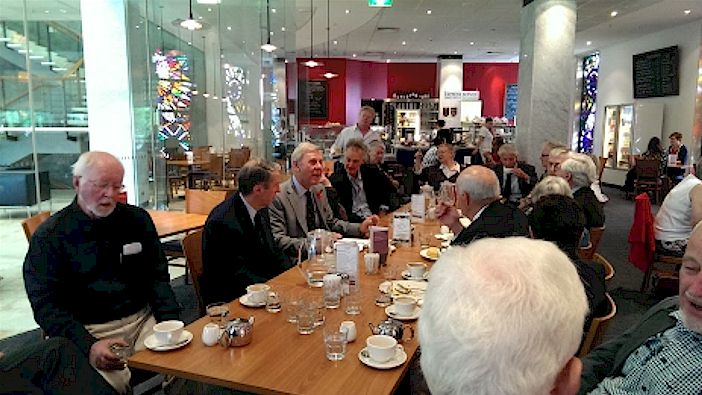
One aim of Capt. Barritt’s journey was to draw together existing members of the Society. In Canberra, Dr Woods convened a happy gathering including Frank Wheatley and his wife Barbara who had travelled all the way from West Australia. After discussions with the President, the group viewed some of the library’s treasures, carefully chosen by Dr Woods for their relevance to the work of Matthew Flinders. Afterwards the members were joined by an enthusiastic audience for the lectures.
Thursday 18 December 2014
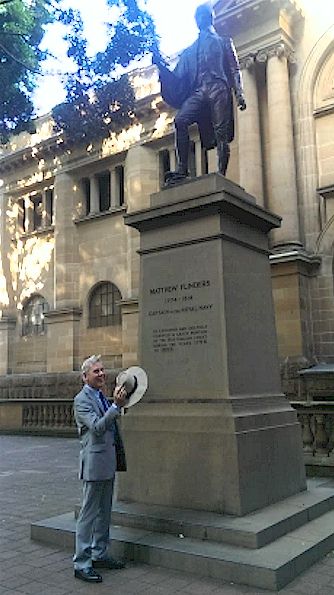
In 2014, Australia commemorated the bicentenary of the death of Captain Matthew Flinders, the Royal Navy Captain who charted much of the coastline of the continent. The Hakluyt Society is proud to have played a part in the festivities. It was particularly fitting that the current President of the Society, Captain Mike Barritt, a former Hydrographer of the Navy, was able to join in a programme of events planned by Dr Martin Woods and other fellow members. The focus was the Society’s forthcoming scholarly edition of Flinders’ journals from the circumnavigation in HMS Investigator, and Captain Barritt was accompanied by the editor, Professor Kenneth Morgan. In this post, the President relates his experiences.
Saluting Captain Matthew Flinders
The success of this launch event was matched by the experience of Captain Barritt and Professor Morgan in a special session in the Fridays at the Library programme run jointly by Flinders University and the Friends of the State Library of South Australia in Adelaide, and finally an evening presentation in the State Library of New South Wales. Through these events Captain Barritt had the opportunity to meet many long-standing members, some others now returning to the fold, and some new recruits.
The programme matched his desire to engage with the Hakluyt Society community that ‘compasses the Vaste Globe’ and to promote events further afield than London.
In his own presentation, Captain Barritt introduced Australia Circumnavigated: The Voyage of Matthew Flinders in HMS Investigator, 1801-1803, placing it in the context of the Society’s history of publications of accounts of travel and exploration in the region. He noted, however, that the edition departed from precedent in the amount of navigational detail that had been retained and reproduced both in the journal itself and in the accompanying memoir explaining the construction of Flinders’ charts. Speaking as a practitioner, and quoting from the memoir, he argued that this evidence of meticulous practice was essential to bring out the under-tone running through Matthew Flinders’ writings. He was acutely aware that he was walking in big foot-prints, especially those of the already legendary James Cook.
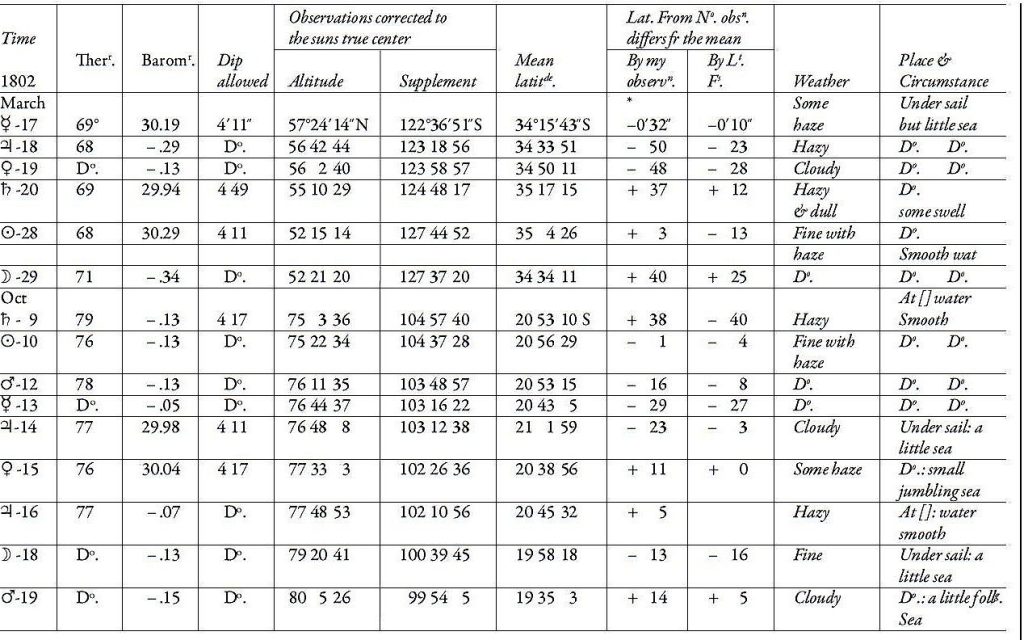
Although the argument and supporting tables in this edition may only be examined in detail by specialists, they illustrate the concerns driving Flinders: ‘I hope to escape the censure of those who may think that our investigation has not been sufficiently minute’. Captain Barritt explained that as a consequence of the decision to include this level of detail, the edition has set challenges at every stage of editing, type-setting and proofreading. The interest in the proof copies made available for inspection at the events in Australia indicates that the volumes will be in demand by both academic and general readers (Distribution to members of the Society took place during the Summer of 2015.).